
Healing Is Not Linear: Why Old Patterns Come Back When Life Changes
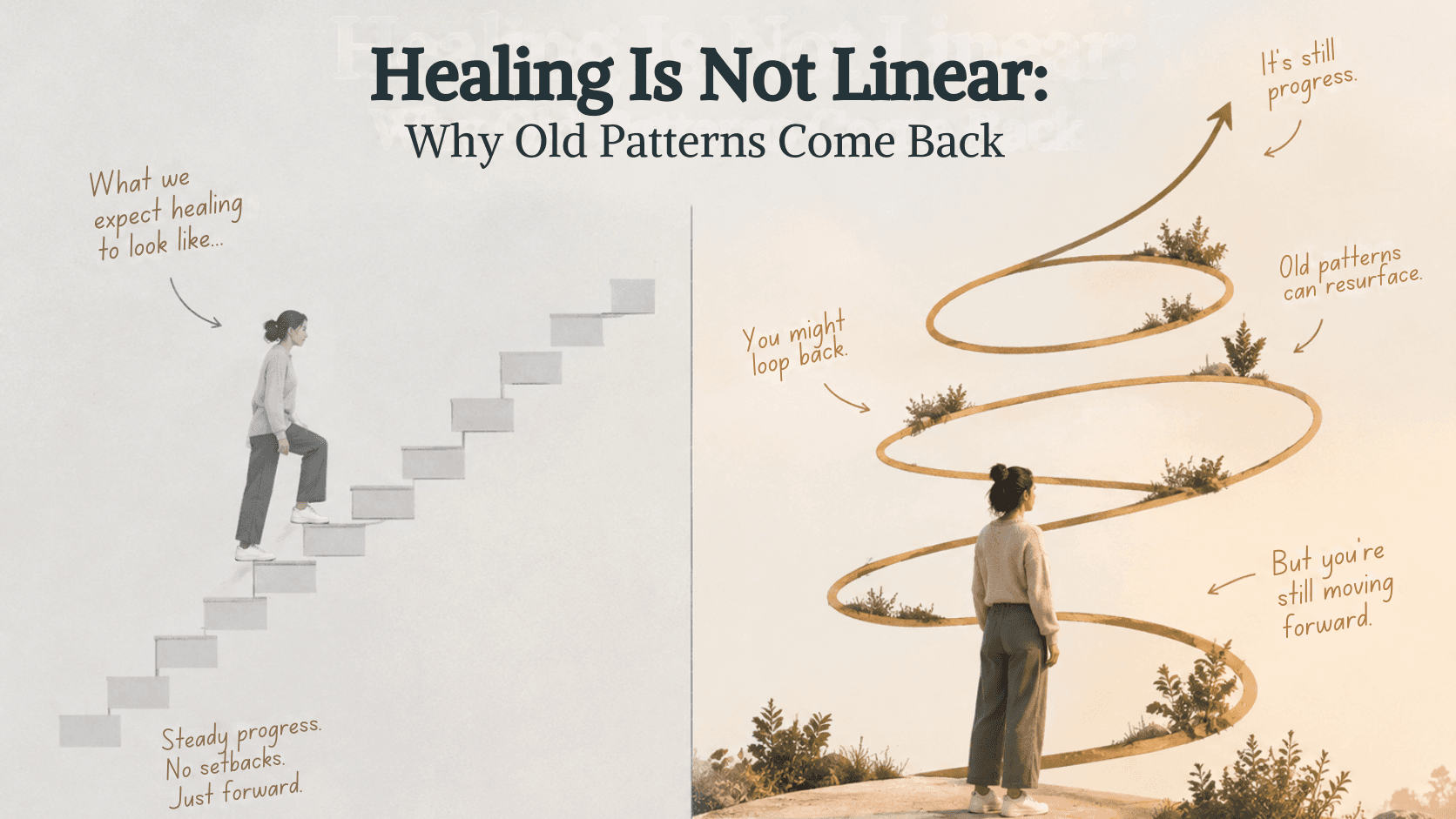
Quick Answer: Healing is not linear because participation keeps changing the conditions. Entering a new relationship, role or responsibility creates demands your earlier development was never tested against. When old protective patterns reappear, it usually means you have moved into new terrain not that you have lost the ground you gained.
Why Healing Is Not Linear
Developmental theories get drawn as journeys with endpoints. You move from dysregulation to regulation, from insecurity to safety, from restricted functioning to growth, and eventually arrive somewhere that looks like completion.
The appeal is obvious. Development is far easier to explain when it can be organised into stages you finish in order.
Human life rarely cooperates.
Human Expansion Theory places participation as the fifth developmental condition, but that position is not a finish line where safety, capacity, availability and expansion have been permanently secured. The conditions are developmental in logic and recursive in operation.
Participation does not happen after development finishes. Participation creates experiences that change the developmental conditions again.
The Staircase Problem
If you treat development as a staircase, every difficult period after progress reads as falling down it.
That framing causes real harm. Someone who becomes more activated after becoming more visible concludes they have lost their regulation. A new parent experiences a dramatic drop in capacity and decides the previous work failed. Someone entering intimacy meets old protective patterns and reads their return as proof that nothing ever changed.
A recursive model offers a different reading of exactly the same evidence.
New participation has generated a new developmental environment. What you are meeting now may genuinely require additional capacity, support, learning or integration not because you went backwards, but because you went somewhere.
Participation Tests What Development Built
Actual life generates demand. This is not a flaw in the process; it is the process.
A new relationship introduces relational uncertainty. Parenthood changes what capacity is required. Leadership creates greater complexity. Illness can alter safety and resource availability. Success creates visibility and expectation. Loss reorganises priorities and emotional access.
Even change you badly wanted can produce new protective responses, because you have entered conditions your previous experience only partly prepared you for.
This connects to contemporary resilience theory, where resilience is increasingly understood as a dynamic process rather than a stable quality acquired once. Bergeman and Nelson (2024) frame adaptation as a process involving stress exposure, reserve capacity, adaptation and consequence. Stress-resilience research similarly describes adaptation as continual learning and plasticity rather than the achievement of a permanently resilient state (Hermans et al., 2025).
Same Person, New Environment
A new relationship makes this concrete.
You might enter it with substantial safety, capacity and availability. Then intimacy introduces dependence, vulnerability, disagreement, attachment and uncertainty and activates forms of protection that were not previously visible.
That does not mean the earlier development was false. The environment changed.
Leadership works identically. You develop enough capacity to take on a larger role. The larger role then brings greater complexity, visibility and decision consequence. Capacities that were entirely sufficient at one level may need recalibration at the next.
Expansion creates new demand. That is what expansion is.
Development Is Domain-Sensitive Too
The recursive structure also stops this becoming a ladder people get ranked on.
You can show substantial participation in professional life and limited participation relationally. You might have great availability in intimate relationships and very little under occupational pressure. You might expand confidently into intellectual challenge while staying highly protective around visibility.
Development is domain-sensitive as well as recursive. "How far along are you?" is not a question with a single answer.
Participation Produces New Information
Participation is powerful precisely because it generates data you cannot get any other way.
You discover what happens when you speak, love, lead, rest, create, receive, fail, succeed, set boundaries and become visible. Some of those experiences strengthen what you already learned. Others expose what still needs developing.
So participation does not simply express development. It produces developmental information.
This shows up most clearly between participation and safety. A boundary is expressed and the relationship survives. A leader delegates and the organisation stays functional. Someone becomes visible, receives criticism, and remains intact. Each of those modifies what you expect next time.
When Participation Reveals Real Danger
But participation can also reveal genuine danger, and this deserves equal weight.
The boundary is punished. The relationship is coercive. The workplace is exploitative. The support turns out to be unreliable.
Human Expansion Theory has to stay open to both kinds of information. Participation is not a mechanism for proving the world is safe. It is contact with reality, and reality is mixed.
Which is why protection remains necessary even at the highest level of the framework. Participation does not describe a life beyond protection. It describes a life where protection is integrated with a wider repertoire.
A Bigger Life Is Not an Easier Life
The same recursion applies to capacity, and it is worth being honest about.
Meaningful participation uses resources. A creative project can be deeply fulfilling and exhausting. Parenting can be meaningful and capacity-intensive. Leadership can reflect genuine purpose and require substantial recovery.
Participation can increase demand, because there is now more life to resource.
Expansion and participation are not promises of permanent ease. They describe greater access to meaningful life, and meaningful life can be demanding. The distinction is whether that demand is increasingly organised around participation rather than around protection and maintenance.
Some Things You Can Only Learn by Living
Participation also transforms availability.
Relationship reveals needs you did not know you had. Leadership exposes values that only become clear once tested. Parenthood creates emotional experiences that were previously inaccessible. Creative work surfaces ambition, grief, vulnerability or identity.
In that sense, the self is not fully known before participation. Some parts of you become available because participation creates the conditions in which they can emerge.
This may be the most important implication of the framework: development cannot be completed through introspection. There are things you can only learn about yourself by entering life.
The Loop
So the sequence bends back on itself.
Safety supports capacity. Capacity supports availability. Availability supports expansion. Expansion supports participation. And participation creates experiences that reorganise all four.
Participation is both culmination and continuation.
The developmental question does not end at can I engage fully with life? Once participation happens, another one follows:
What is this life now asking me to become capable of?
The answer keeps changing, because life keeps changing.
Development is not finished before participation. Participation is where it becomes real, where it gets tested, and where it starts again.
Where This Work Is Applied
Within the Life Beyond Trauma Method, participation is treated as the culmination of the developmental architecture without being framed as permanent completion. New relationships, responsibilities, choices and challenges may require renewed work across safety, capacity, availability and expansion.
Within the Regulation Suite, ongoing practices support the ordinary recalibration life requires, rather than being used to maintain an imagined permanently regulated state.
Within Executive Advisory, this recursive principle is central to the consolidation and continuation phase. Increased leadership participation creates new demands, and the system has to be recalibrated as responsibility, organisational complexity and visibility change.
Frequently Asked Questions
Why is healing not linear? Because life keeps changing the conditions. New relationships, roles, losses and successes create demands your earlier development was never tested against, which can reactivate protective patterns without any ground being lost.
Is participation the final stage of Human Expansion Theory? It is the fifth developmental condition, but not a permanent end state. The conditions interact continually, and participation itself reshapes the four that precede it.
Why do old patterns return after I have made progress? New circumstances can activate demands, relationships or uncertainties that simply were not present during earlier development. The pattern returning is usually information about the new situation, not a verdict on the old work.
Does this mean development never ends? Human beings keep adapting throughout life. The aim is not endless self-improvement, but greater flexibility in responding to changing conditions.
Can meaningful participation reduce my capacity? Temporarily, yes. Meaningful activities can be genuinely demanding. Participation therefore has to stay connected to resource availability and recovery.
How do I tell a setback from a new challenge? A useful question is whether the difficulty appeared alongside a change in circumstances. Old patterns surfacing in genuinely new terrain is different from losing something you had established in familiar conditions.
About the Author
Caroline Reed, MA, MBACP is a psychotherapist and trauma specialist with more than 25 years of professional experience and founder of The Nervous System Institute. Her work focuses on the relationship between nervous system function, protection, human capacity, and participation in life. She is the developer of Human Expansion Theory, an emerging theoretical framework exploring the developmental conditions of Safety, Capacity, Availability, Expansion, and Participation.